

Before giving my AI agent access to all my health data, I gave it a constitution.
Its highest-priority goal is to maximise the probability of me reaching my 90th birthday in excellent physical and mental health. Beneath that sits present-day health and wellbeing, aesthetics and athletic performance. In that order.
The ordering matters and goals matter. Health is not a single value to maximise. Losing weight may improve one set of risks but compromise muscle or energy. Training harder may improve athletic fitness but increase injury risk. A drug that improves sleep may leave me less mentally sharp. An AI agent that does not understand what I am trying to achieve can optimise the wrong thing.
I am trying to build something far more ambitious than a health chatbot: a universal personal health agent that can accumulate evidence across my lifetime, work alongside my doctors, learn from experiments and data, intervene constructively in my day-to-day life and become more effective as both AI and medical science improves.
The full version I imagine is still ahead of me, but something recognisably like it is now remarkably possible. The models are early, the integrations are imperfect and much of the operating discipline is still being iterated. But enough of the technology exists that I have started building it for one human being: me.
What I am building is less a full health application than the substrate for one: a fully patient-controlled medical health record organised around a person rather than an institution, preserving not only conclusions but where they came from and how certain they are. The agent reading that record will be replaced many times. The record itself must grow and last.
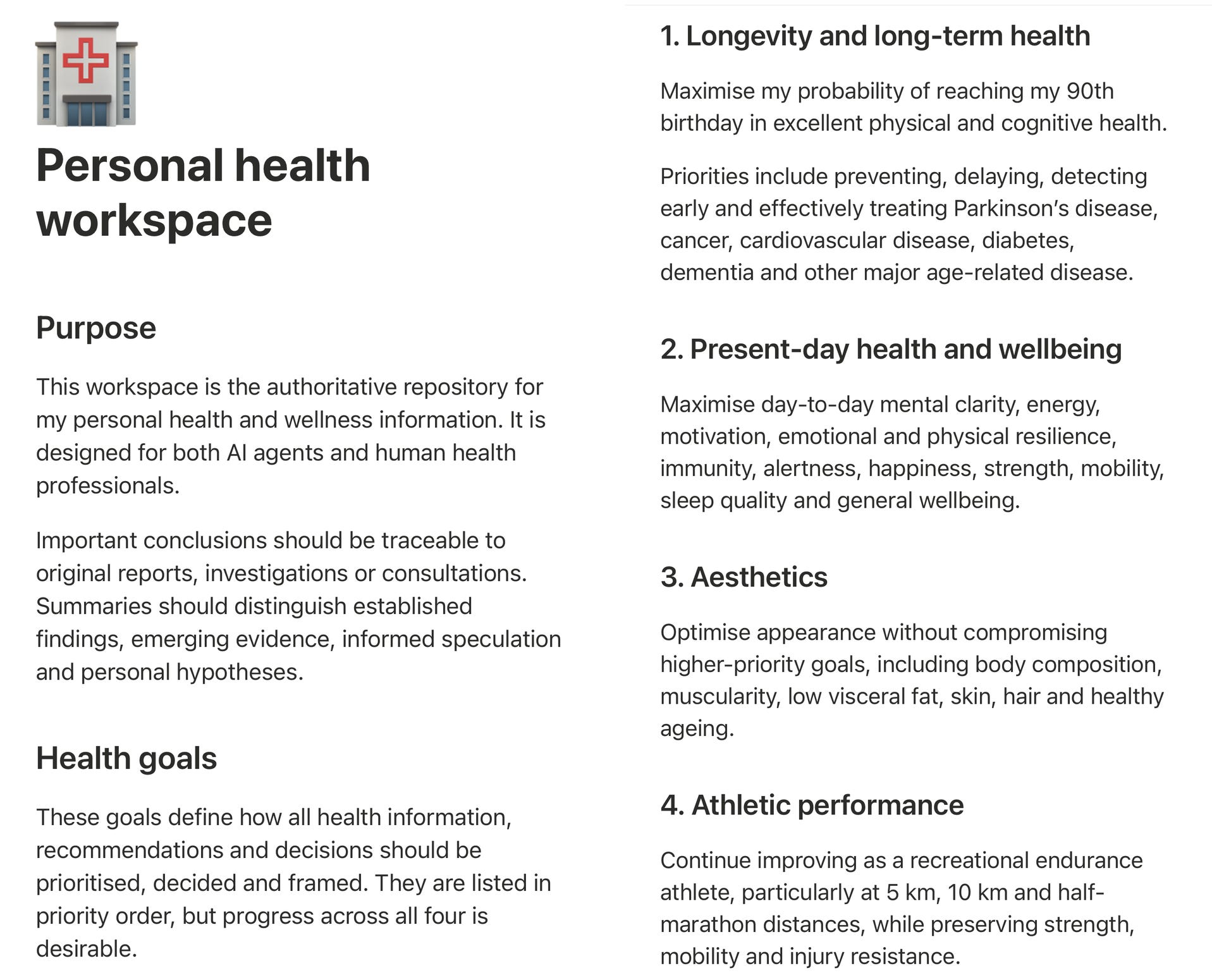
Figure 1. The constitution of my personal health AI agent. Before it can reason about my health, the agent needs to know what “better” means and how competing objectives should be prioritised...
Medicine remembers appointments. I want AI that remembers a life.
Today’s health information is extraordinarily fragmented.
A hospital remembers appointments. A primary-care record remembers prescriptions and diagnoses. A laboratory remembers test results. My Oura ring remembers sleep, activity and physiology. A Withings scale remembers weight. My Garmin watch remembers my runs. I sometimes remember symptoms, meals, conversations with doctors, why I agreed to a treatment and the questions I forgot to ask. Some of these memories are wrong and most eventually disappear.
Even when the data exists, it typically lives in separate systems designed for different purposes. The organising principle of a medical record is often the institution and the encounter, rather than the continuing life of the patient.
I want to turn that fragmented record inside out. The organising principle should be the person. The system I am building should be able to absorb essentially any kind of information that does, or might, matter to health, and connect it over time. That means breadth across all domains and data types: blood tests, imaging, genetics, medications, symptoms, sleep, diet, exercise, research questions, mood, consultations, photographs and whatever new classes of evidence become useful later.
This is not just a long-term medical record. It is a patient-controlled, continuously updated model of a life, designed from the outset to be usable by both humans and AI agents.
It should know what happened, why it happened, what we currently believe, how confident we are, what remains unresolved and what should happen next. All pointing back directly to the evidence.
An intelligent health agent therefore needs more than just access to data. It needs explicit goals, rules about what counts as evidence, a disciplined way to represent uncertainty and a detailed model of the person it serves that is continuously kept up-to-date.
A living health model, not a filing cabinet
My current implementation is built around a health workspace stored in Notion and an AI agent I’ve called Aster.
My workspace contains original clinical documents, structured measurements, treatments, observations, nutrition, alcohol and caffeine events, health hypotheses, experiments, specialist interactions, open health questions and a continuously updated synthesis of my health status.
The distinction between evidence and interpretation is crucial. Original documents are preserved. Structured facts should point back to their sources. Measurements are distinguished from estimates and contain error bars. Hypotheses are distinguished from established findings. Current treatments are distinguished from historical treatments.
Uncertainty is not something to be ignored or tidied away. It is part of the data.
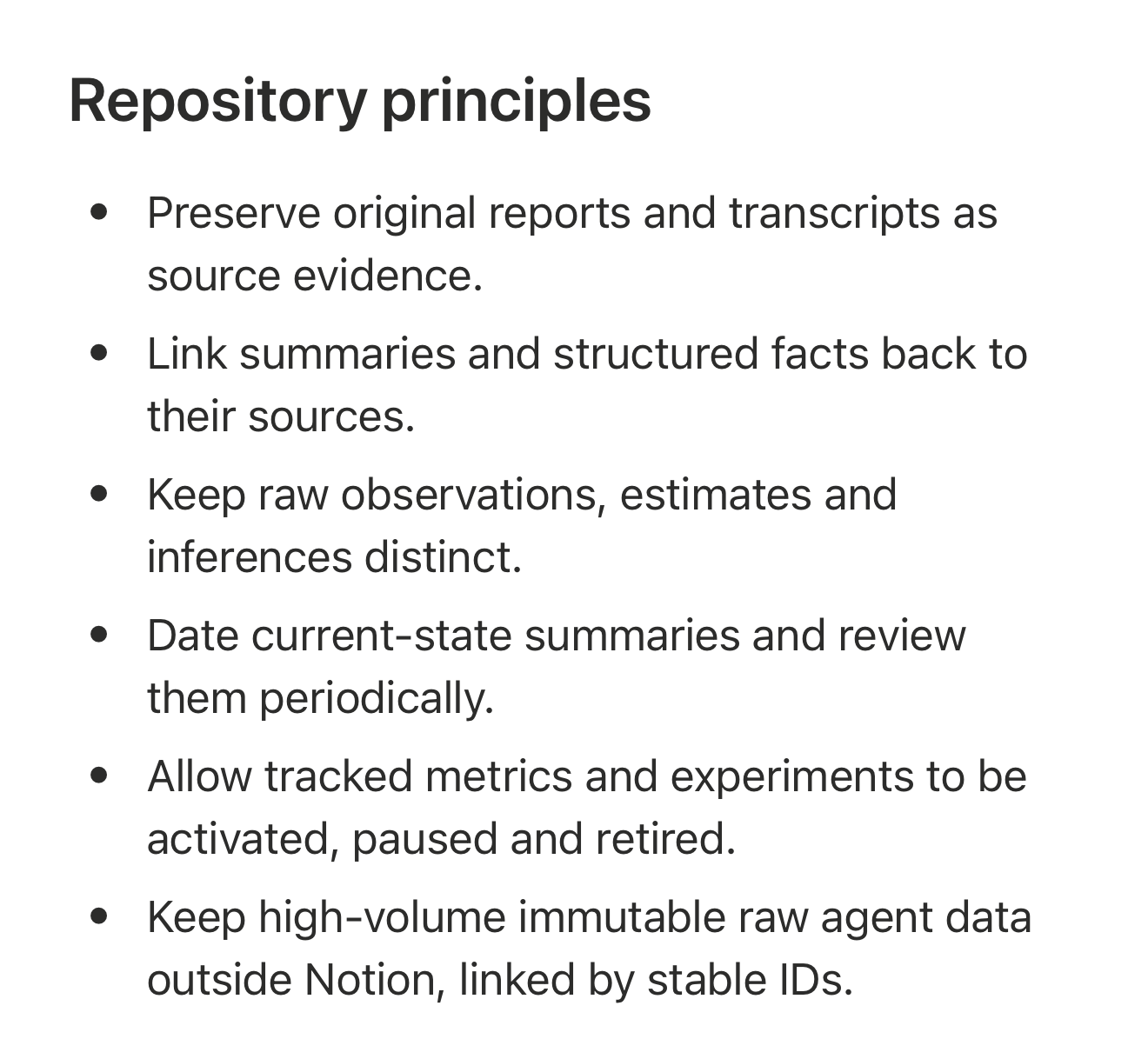
This matters because the current model is temporary. The health history is not.
I expect the AI models I use in two, five or ten years time to be dramatically better than those I use today. Medical science will also improve. I therefore require the underlying evidence to survive the particular intelligence that first built and interpreted it.
My current AI agent will be replaced many times. The history it is building should last my lifetime.
AI as a new kind of health sensor
Wearables have already transformed one part of this problem. Without doing anything other than occasionally recharging my devices, I can collect huge quantities of data about sleep, heart rate, HRV, exercise, movement and many other aspects of physiology.
However, until recently one enormous plank of my health data was missing: everything that I consume. Nutrition data was completely absent.
Food logging applications work tolerably when somebody eats a packaged product with a barcode or carefully weighs every ingredient at home. Real life is dramatically messier.
I eat in restaurants and get food delivered. I share dishes. I taste somebody else’s starter. A plate arrives with an unknown amount of oil. I eat half of something and take the rest home. I eat the leftovers the following day or throw them away. A menu omits ingredients. I photograph a dish before eating it and then remember later that I left most of the sauce. Drinks arrive at different times.
Representing all of this accurately by hand is so tedious that almost nobody will do it consistently for long.
However, the AI agent I built moves this from a data-entry chore into something that can happen almost as a by-product of ordinary life. On a typical day the active effort is only a few minutes, mostly taking photographs, brief text or voice notes and occasionally correcting the agent.
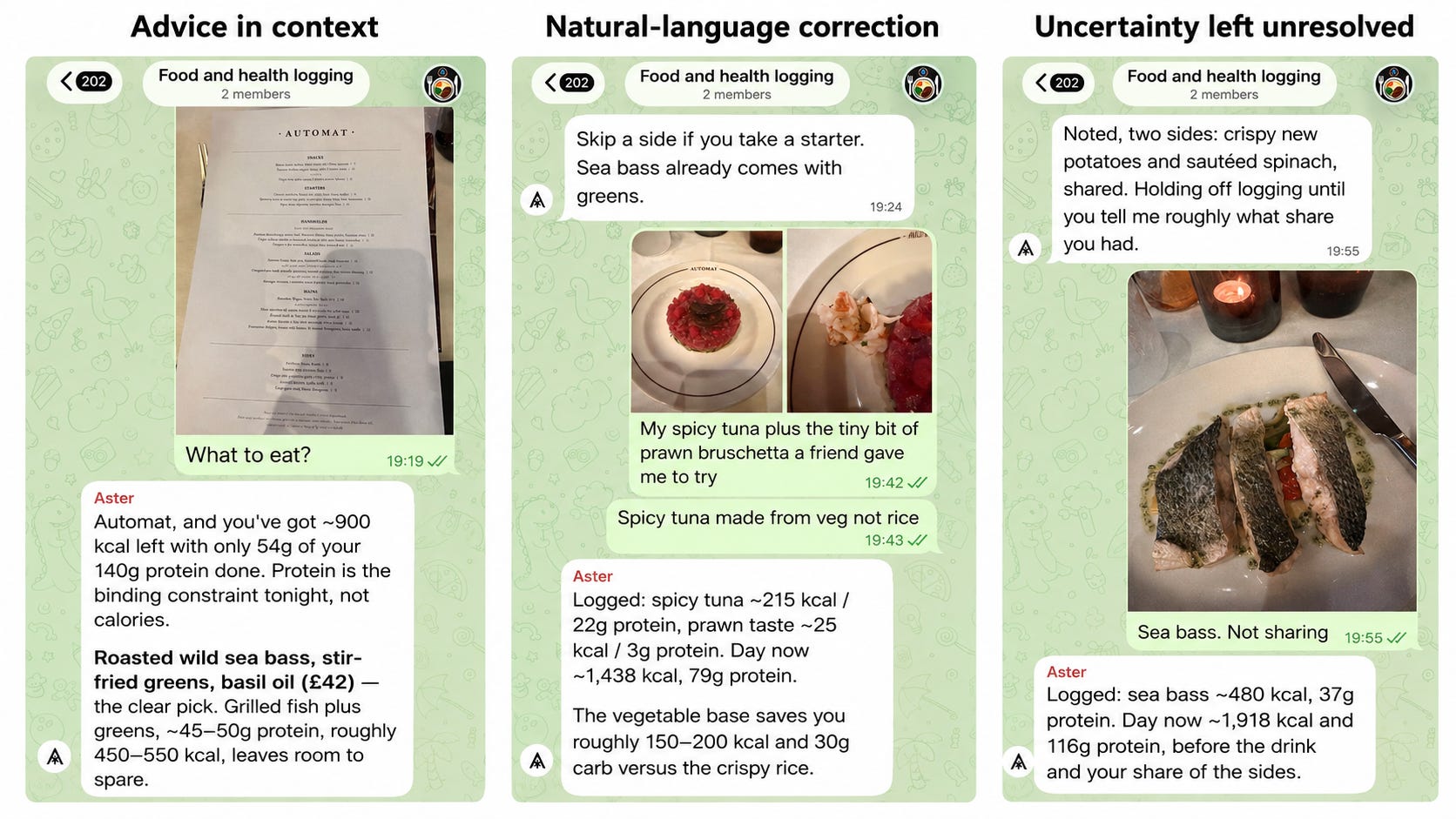
I can photograph a menu and ask what I should eat. The agent knows what I have already had that day, which nutritional goals currently matter and even my preferences. I can photograph my starter and say that the spicy tuna is made with vegetables rather than rice. It updates its estimate. I can photograph my main course and say it is mine while the side dishes are being shared. Rather than inventing a portion, it can wait until I tell it roughly how much I ate.
The transformational capability is not recognising a sea bass. It is understanding the complex, real-world semantics of an actual meal.
AI is becoming a kind of semantic sensor: it can turn messy human events into analysable, structured data without requiring human life itself to become machine-readable.
The estimates deliberately preserve the uncertainty. A restaurant meal might have a central calorie estimate with a wide plausible range. That is much more useful than pretending that a photograph can reveal an exact number.
Crucially, the raw evidence survives the estimate. The agent retains the photographs, original descriptions, timestamps, assumptions and corrections. A future vision model may estimate the same meal better. It may know more about the restaurant, ingredients, portion sizes or my own patterns. Historical data can therefore be revisited and improved rather than permanently frozen at the quality of today’s model.
If the raw evidence survives, the historical health record can retrospectively improve as the interpreting intelligence improves.
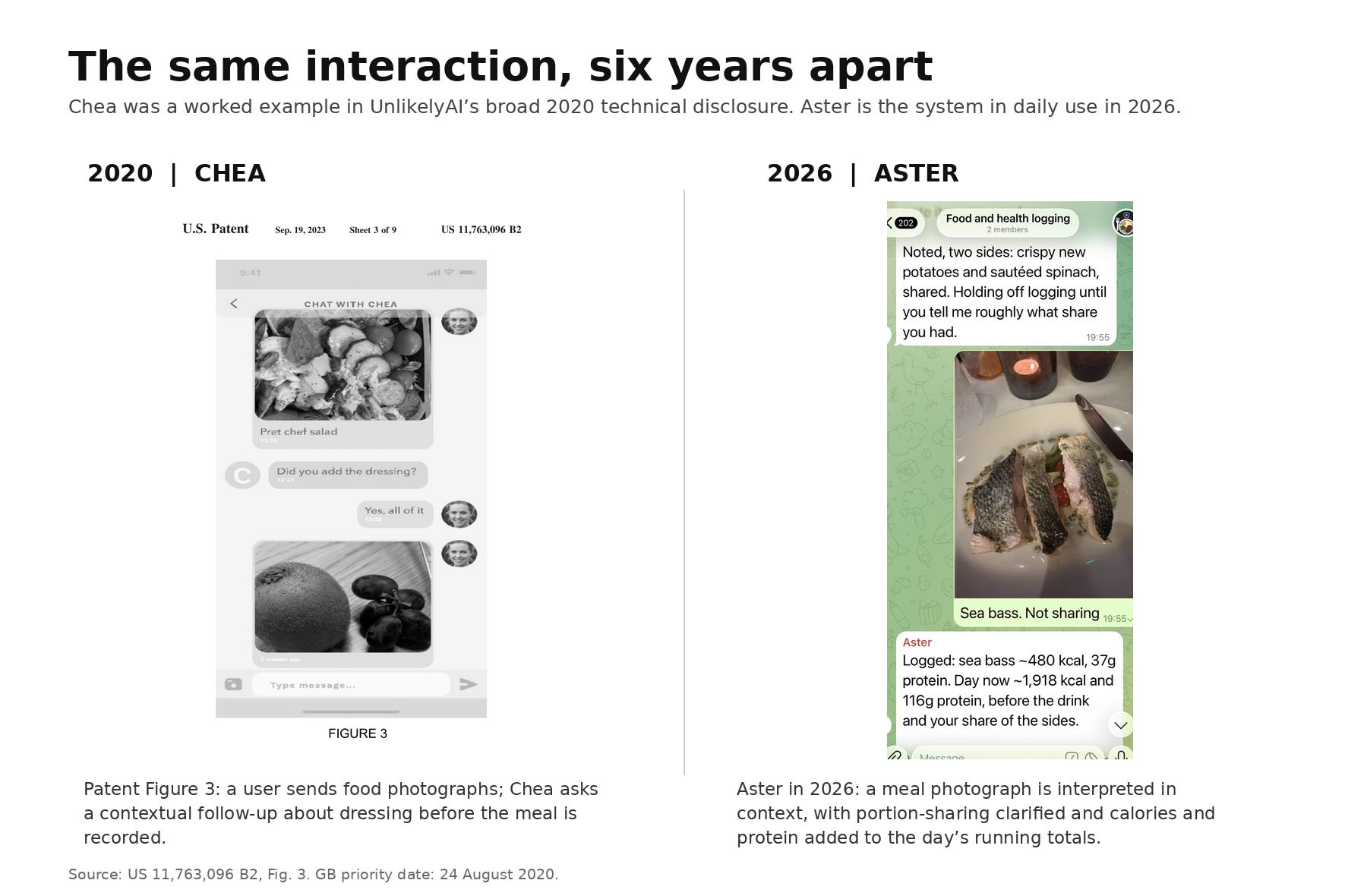
Much of this was designed by me in 2020. I included a worked example called Chea in the broad technical disclosure underlying UnlikelyAI‘s patent filings. One patent figure shows a user sending food photographs while Chea asks whether the dressing had been added to the salad.
The same disclosure described uncertainty about food composition and portion size, combined nutrition with sleep and other health data, possible dietary intolerance inferred from accumulated data, and caffeine at bedtime compared with wearable-derived sleep quality. This was implementable then. What has changed is the friction and the development effort: semantic machinery that would once have required significant bespoke engineering can now be implemented by a general model inside an ordinary conversation and built by me as a personal project.
From data to personal understanding
Collecting data is only useful if it improves what I understand and what I do.
A recent example is sleep. I had a long-standing form of insomnia where I would often wake in the early hours and sometimes remain awake for a long time. In June, I started taking daridorexant, a medicine from a newer class of sleep drugs.
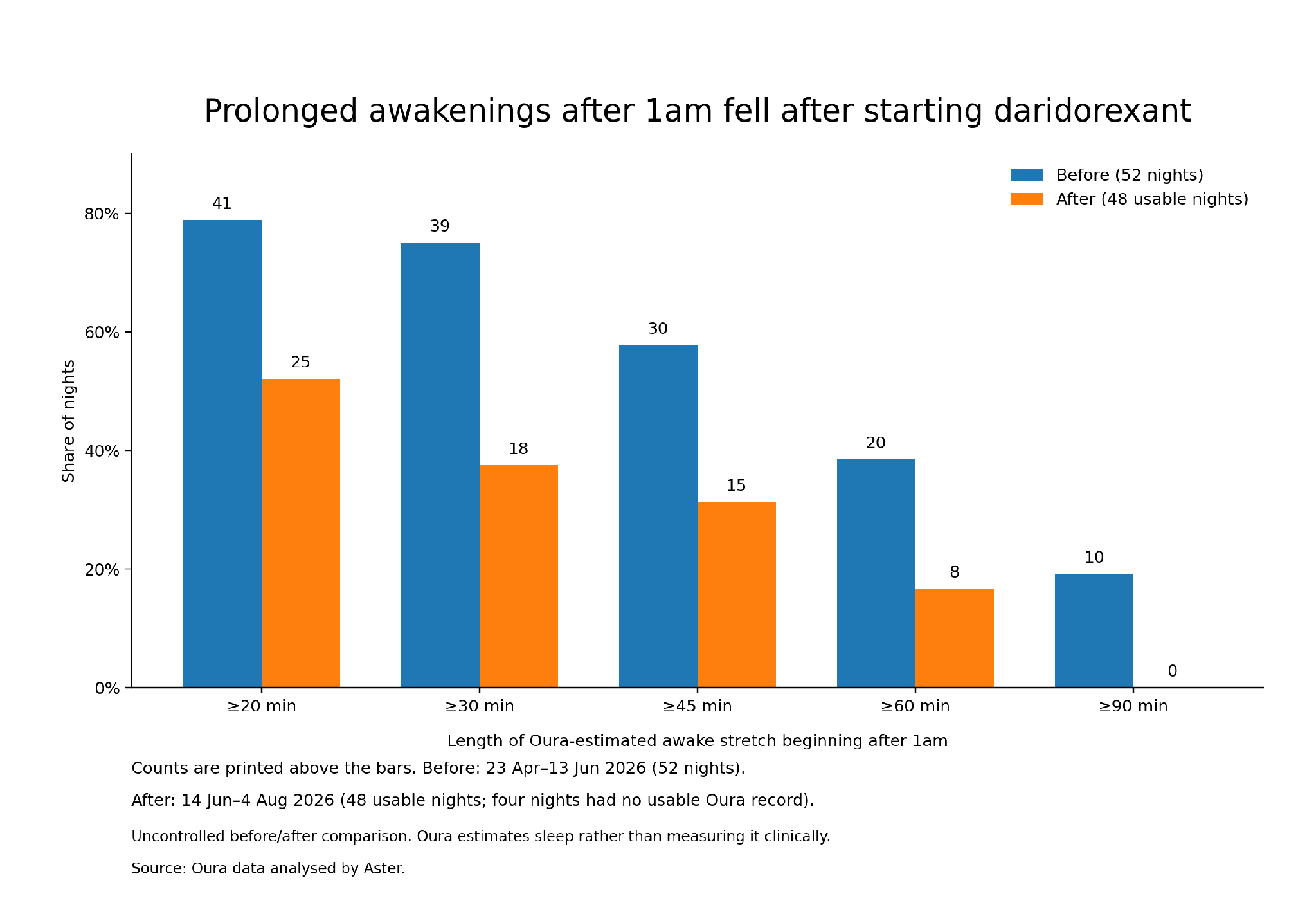
My Oura ring had already collected the before-and-after data and these metrics had been automatically imported into my health workspace. But the interesting question was not just whether my generic sleep score changed. It was whether the specific problem I was taking the medicine for had improved.
Aster compared adjacent periods before and after treatment and examined prolonged stretches of being awake beginning after 1am. The reduction was striking. It also found something I had not appreciated: my total sleep had improved much less than the reduction in night-time wakefulness because my bedtime had gradually crept later. The drug appeared to be fixing the problem I cared about, while a behavioural change, probably encouraged by sleeping better, was giving back some of the gain. That was immediately useful. The analysis was not a clinical trial and Oura is not a polysomnograph but it quantified something important that matched my subjective experience and gave useful evidence to take to my sleep consultant.
The episode also exposed one of the dangers of 2026 AI. An earlier analysis focused on the wrong metric, constructed a plausible but invented story around it and attributed a complaint to me that I never made.
A personal research programme
The more interesting questions go beyond just analysing my own measurements.
I carry the LRRK2 G2019S genetic variant, which substantially increases my lifetime risk of Parkinson’s disease. I do not have Parkinson’s disease, but reducing the risk of developing it is one of my most important long-term health objectives sitting alongside other major age-correlated diseases such as heart disease and cancer.
That creates questions that are highly consequential to me and unusually personalised.
Another idiosyncrasy: I have drunk coffee daily with almost 100% consistency since I was six years old. There is epidemiological evidence associating caffeine consumption with lower Parkinson’s risk, and there is research specifically including LRRK2 mutation carriers. But observational associations are not the same as proof that drinking more coffee will reduce the risk. There are competing explanations and many uncertainties. At the same time, caffeine also has consequences for sleep, which is another important health objective.
The useful question is not the general “Is coffee healthy?” It is something far more personalised: given my particular LRRK2 variant, family history, decades of daily coffee consumption, current intake, sleep profile and goals, what does the totality of current evidence imply about what I should actually do? Using the best data and the best hypotheses about mechanism, should I delay drinking coffee after waking? Does more caffeine plausibly have more benefit? Does the percentage of the 24-hour period that I am caffeinated matter?
That is a research problem a capable reasoning model can now investigate across the scientific literature while drawing on my entire health repository for personal context.
The results should not disappear into a chat transcript. It should instead become a durable research artefact in my health record: the question, the relevant personal facts, the literature reviewed, competing explanations, the current conclusion, importantly the confidence in that conclusion, the behaviour it recommends, and the date or circumstances under which it should be reviewed.
Then the answer can change.
A new LRRK2 trial or scientific paper might be published. Other literature may shed light on a plausible mechanism. Better evidence about caffeine may emerge. My sleep might change. A qualified neurologist may disagree with or want to modify the agent’s conclusions. A future more intelligent model may reason about the evidence better than today’s.
The system can then reopen the question rather than starting again from scratch.
This creates a loop I find particularly exciting: personal history to personalised research question to world medical literature review and provisional conclusion to behaviour maybe combined with a measured outcome to new evidence and to having that conclusion revised.
That is much closer to a personal research programme than a conventional medical record.
Learning from one life
The other source of evidence is my future behaviour.
Most health questions will never have a randomised controlled trial precisely matching my circumstances. Some are too idiosyncratic to justify one. Others concern optimisation rather than treatment.
Does morning interval training make me more alert and productive that afternoon? Does moving caffeine earlier improve sleep without sacrificing daytime performance? Does a longer time period between my final calories and bedtime improve sleep or recovery? Does a fixed bedtime improve total sleep?
These questions are susceptible to very poor self-experimentation. Humans are excellent at remembering the result we wanted, changing three things simultaneously and assuming the result was from one of them, finding an interesting correlation after looking at the data and ignoring negative experiments.
An agent can make methodological discipline cheap.
An agent can state the hypothesis before the experiment, define a primary outcome, establish a baseline, record adherence and confounders, preserve negative results and distinguish exploratory correlations from pre-specified tests. It can also recommend replication or gathering more data before a weak signal changes long-term behaviour.
None of this turns an “N-of-1” experiment into a clinical trial. It does however make careful personal learning possible in situations where the administrative effort would otherwise greatly exceed the value.
A shared intelligence layer for both doctors and patients
Today, I do not see this as a replacement for my doctors. It makes me a better-informed patient and gives them a much richer, better-organised picture of what has happened between consultations.
Doctors have expertise, judgement, an ability to do physical examinations, access to clinical systems, the ability to order tests and prescribe drugs and they take responsibility for medical decisions. The agent has different advantages: essentially unlimited time, continuity, memory, computation, continuous ability to communicate with the patient and access to the broad health record described here.
Before an appointment, an agent can assemble the relevant history, retrieve source documents, quantify a symptom or treatment response, identify contradictions and prepare the questions that most matter. Afterwards, it can ingest the clinical letter, update treatment status, record why a decision was made, track tests and follow-ups, and monitor the outcome that the doctor and patient agreed mattered.
This can work in the other direction too: a doctor can review a personalised research analysis created by an agent, challenge its interpretation and leave a more authoritative conclusion. My daridorexant analysis already followed this pattern in a modest way: the agent assembled and analysed the evidence, and I took the result into my consultation with my sleep specialist.
But I do not think the long-term destination stops at better preparation for human doctors. As AI becomes more capable, reliable and trusted, personal AI health agents will evolve towards something much closer to a superhuman personal physician: continuously present, knowing the patient for decades, able to read every relevant paper, remember every prior decision, observe far more of daily life than any doctor can, and call on human clinicians when physical examination, procedures, accountability or legal authority are needed.
I want to be specific about what changes, because the word “superhuman” is doing less work in what I said above than the word “personal”. The scarce resource in medicine is attention as much as knowledge. Care is rationed into appointments, while almost everything that happens to the patient happens between them. A continuously present agent inverts this: the record stops serving the encounter, and the encounter starts serving the record. Medical reasoning no longer has to occur only in brief moments separated by weeks or months.
That is a large claim, and it raises big questions about regulation, liability and professional roles that I am not going to settle here. It is also another reason to build the underlying memory and evidence system now. Whatever level of medical responsibility future agents attain, they will be better if they inherit a trustworthy history rather than starting with an empty database.
Trust is an architectural problem
The failures in my current agent are more than amusing anecdotes. In health, they can be highly consequential. They are also the AI Trust Ceiling in miniature: the gap between a system being extraordinarily capable and also being reliable enough to trust and use without qualification.
I have written before about this problem. Current neural AI can be remarkably capable while still hallucinating, behaving inconsistently and producing confident errors. Those weaknesses are tolerable in some applications and unacceptable in others. Personal health sits very firmly in the unacceptable category.
Aster has repeatedly given me remarkably concrete examples of this problem.
My agent has at various times treated an inadequate search as evidence that something did not exist, written health records into the repository without following the rules, allowed hard-coded targets to become stale and even hallucinated the date on which I started taking a drug. One of its more embarrassing mistakes was building an alcohol clearance model that applied the liver’s processing rate independently to every drink, rather than to the pooled alcohol in the body. In effect, every extra drink gave me an extra liver. The arithmetic was internally consistent but the results were physiologically absurd.
Each class of failure needs addressing with a structural response.
Clinical facts should be linked to evidence. Negative findings require adequate searches. Current goals should be read from their canonical source rather than inferred from the context. Estimates should retain their uncertainty. Derived conclusions must be distinguishable from observations. An all-clear needs the same evidence as an alarm. Data should be periodically and independently checked and validated.
The operating procedures that accumulate around the agent can be thought of as scar tissue: each important failure should leave behind a rule that makes the same category of mistake less likely next time. Whether iteratively repeating this approach is enough remains to be seen.
Why I can currently only build this for me
An obvious question: if this is useful, why not build it for everyone?
For now, the system has one user because I occupy an unusually convenient position. I am the data subject, the operator and the human deciding which risks to accept.
I can choose to give my AI agent access to deeply personal medical information, food photographs, genetic data and wearable measurements. I can experiment with the architecture and inspect its mistakes.
The moment this becomes a service for other people, the situation changes. Privacy, security, consent, clinical safety, liability and medical-device regulation all move into the frame. HIPAA in the United States applies to covered entities and their business associates, not generally to an individual handling his own health data; in the UK and Europe, health and genetic information attract particularly strong protection under data protection laws. A commercial system that makes claims about diagnosis or treatment may cross further regulatory boundaries.
These are solvable problems, but they are also real ones.
Building for myself lets me explore the destination as a personal project before all the roads and institutions needed to reach it at scale have been built.
I also think the fragmentation of data I described at the start is largely a choice rather than a fact of nature. Records are organised around institutions and encounters because those institutions provide the care, pay for systems and carry much of the responsibility, not because that is the best way to understand a life. Much of the missing infrastructure is plumbing rather than frontier intelligence.
Three things would have to be true for this to become broadly available. Patients would need a real right to a complete, machine-readable copy of their own record, not just a portal or a stack of PDFs. Provenance would need to become a standard rather than personal discipline: a common way to say what a claim is, where it came from, how certain it is and whether it can be recomputed. And the format would ideally need to be independent of any model or vendor so that a history can outlive the company that first stored it.
None of this requires a scientific breakthrough. It requires institutions and standards to align around the idea that the patient should be the organising principle. The danger is that the first generation of health agents locks in formats that suit their makers rather than their users.
The data will outlive the model
Given what I have built today, imagine the agent I might have in 2030, 2035 or 2040.
It may be able to reason simultaneously across genomics, medical imaging, blood chemistry, continuous wearable streams, diet, exercise, medication exposure and decades of subjective observations. It may be able to build much better causal models. It may coordinate specialist agents and collaborate directly with clinicians. It may understand diseases in ways that medicine does not today.
Human medical knowledge will advance too. A genetic variant whose consequences are uncertain now will become actionable. A biomarker collected for one purpose may acquire a different significance. An old photograph or laboratory result may answer or prompt a question nobody knew to ask when it was collected.
This is why preserving evidence matters so much.
The health record will become more valuable in two independent ways: as the intelligence reading it improves, and as humanity’s knowledge of health advances.
The case does not depend on AGI. Each generation of more capable agents can extract more value from the same history.
But there is one thing a future super-capable agent will not be able to do.
It cannot reconstruct the years we failed to record.
It cannot know exactly when a symptom began if nobody captured it. It cannot recover a forgotten reason for changing a medicine. It cannot inspect the photograph of a meal that was never stored. It cannot distinguish an old estimate from a measurement if the provenance was discarded. It cannot know which outcome mattered to me at the time unless somebody recorded it.
Intelligence can arrive later. History cannot.
That is why I am building the memory now.
I want a health agent that will know me for life. The agent I use today will not be that agent. But, if I build the substrate correctly, it can start creating the evidence, memory and history that every better agent after it will inherit.
Fascinating reading, thank you so much for sharing, building anything along those lines is way beyond me, so I really enjoy reading about the possibilities that others are capable of.
Substack only just now recommended this piece three weeks after you published it!
I’d say it’s probably one of the most interesting case studies of local agentic private AI I’ve seen. Thanks for taking the time to share.
I’ve only had a very casual experiment with local assistants (nanoclaw+ bits) and protecting personal data long-term, but the vision is the same to some extent:
Access to my personal data must not be constrained by companies that process it at some point in time.
I also get that at this stage — at early prototype stage — generalising is an early and risky optimisation.
The article is also another useful nudge to remind me that the only one who’s going to put my personal data interests ahead of anyone else else’s is myself. I’m not going to get a message from Google saying “you really shouldn’t put all your eggs in our basket — please diversify”
This was the implicit agreement we all signed up to when we moved stuff from our local disks to the cloud. Maybe it’s time to move some of it back.